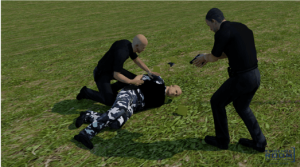
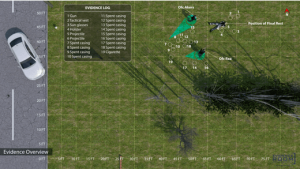
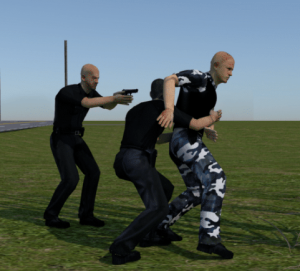
 On December 15, 2019, a series of 911 calls reported a single-vehicle crash on I-76 East in Akron, Ohio. Officers James Rea and Matthew Akera responded to the scene, where they encountered Mohammad J. Isaifan wearing a bulletproof vest with a handgun secured in a black holster on his right side. As the officers approached, Isaifan fled into a nearby wooded area. The officers followed, identified themselves, and repeatedly instructed Isaifan to show his hands and get on the ground. Although he initially complied, Isaifan subsequently stopped following commands, moved toward the officers, and resisted their attempts to detain him. According to the officers’ accounts, Isaifan then reached for the handgun on his hip, drew the weapon, and began turning toward them. The officers responded by firing a total of 15 shots, fatally wounding Isaifan.
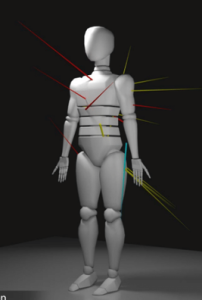 The Evidence Room team conducted an independent excessive-force analysis to evaluate the shooting sequence and determine whether the reported accounts of the incident were consistent with the available physical and forensic evidence. Our team examined officer statements, eyewitness testimony, autopsy findings, ballistic evidence, and scene documentation, comparing each source against the physical evidence to reconstruct the sequence of events. Detailed 3-D animations were then created to visually demonstrate the incident and illustrate how the forensic evidence aligned with the reconstructed sequence. Based on this analysis, Evidence Room concluded, to a degree of scientific probability, that the physical and forensic evidence was consistent with the officers’ accounts of the incident.
KIMBERLEE VAUGHN V. JAMES REA: THE APPEAL
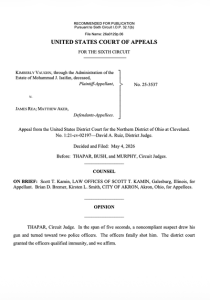
On May 4, 2026, the Estate of Mohammad J. Isaifan, represented by his wife, Kimberlee Vaughn, filed a federal civil rights lawsuit in the United States District Court for the Northern District of Ohio. The lawsuit alleged that the officers involved had unlawfully detained Isaifan, used excessive force, and violated his rights under the Fourth Amendment. The officers sought summary judgment, arguing that, even when the evidence was viewed in the light most favorable to Vaughn, they were entitled to qualified immunity and that no reasonable jury could find their actions unconstitutional. Following the district court’s ruling, Vaughn appealed only the dismissal of the excessive-force claim. The Sixth Circuit ultimately left the district court’s decision unchanged, resulting in the dismissal of the excessive-force claim brought on behalf of Isaifan’s estate. As a result, the officers were not held civilly liable for the alleged use of excessive force. The outcome was consistent with the findings reached through Evidence Room’s forensic reconstruction and analysis of the physical and visual evidence. By carefully examining the available evidence and reconstructing the circumstances surrounding the incident, the Evidence Room team provided an objective assessment grounded in the documented facts of the case. The result further demonstrates the value of thorough forensic reconstruction in complex use-of-force matters, where details such as timing, positioning, movement, perspective, and the sequence of events can be critical to understanding what occurred.