Testing witness accuracy & psychology
The Yerkes-Dodson law explains that when the mind is under intense emotional distress, the brain has issues encoding memories in the way they are accurately presented. The concept of “weapon focus” also emphasizes this, with the idea that when a threat is presumed to be present, the official details can easily be forgotten, if not ignored altogether. The brain codes real-time trauma with a “fight or flight” response lens over reality. Rational processes shut down. And events are stored as fragments rather than entire stories. The amygdala places itself into “survival mode,” and processing becomes purely biological rather than step-by-step processing of a high-stress situation.
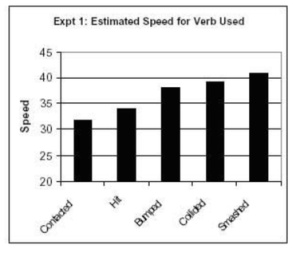 One of the most notable experiments performed regarding witness recollection and psychology was by psychologists Loftus and Palmer to test the way courtroom language impacted a witness’s recollection of an event. A group of people was asked to recall the speed at which a car crashed through different worded questions. Each clip was from five to thirty seconds long, and the car’s speed ranged from a variety of speeds. The questions asked by the psychologist were: “How fast were the cars going when they (contacted/hit/bumped/collidad/ smashed) into each other?” Each time the question was asked, a different verb was used to describe the event.
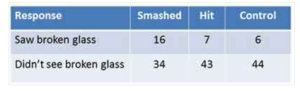 The findings of the experiment showed that participants significantly overestimated the speed at which the car was moving based on the language, the follow-up question was asked. The car’s true speeds ranged from 20-40 mph. Loftus and Palmer followed up a week after this experiment to further assess the accuracy of recollection of specific details at a scene; this emphasis was on the presence of something or not. The question was: “Did you see any broken glass? Yes or no?”
Based on the groups that were asked the original question that tested the wording, the chart states the response. There was no glass in the video.
The overall takeaway from this study is that witness recollection is not, on its own, among the more trustworthy forms of evidence in a case. The result also explained that the representation of memory can be altered based on the emotional wording and weight placed on specific questions, proving a significant risk to the accuracy of testimony and the brain’s ability to store correct information at all times.
EBSCO Information Services. Eyewitness testimony and memory. EBSCO Research Starters. McLeod, S. (2025). & Loftus and Palmer (1974): Leading questions experiment. Simply Psychology.