Investigator’s Notebook
In forensic investigation, some of the most important work happens long before an expert begins an analysis, a reconstruction is developed, or a demonstrative exhibit is created. It begins at the scene with the photographs taken, measurements recorded, evidence collected, and interviews documented. Every case is different, but one principle remains consistent: the quality of the analysis that can be performed later is often directly influenced by the quality of the documentation created at the beginning. Months or years after an incident, the original scene may no longer exist in the same condition. Vehicles may be repaired or destroyed. Buildings may be renovated. Roadways may change. Witnesses’ memories may fade. The investigative record becomes our way of returning to the scene.
Scene Documentation
A well-documented scene should allow someone who was never physically present to understand the environment and the spatial relationships between relevant objects and evidence. Document from the general to the specific: begin with wide photographs that establish the overall environment, continue with mid-range photographs that demonstrate spatial relationships, and finish with detailed close-ups of individual evidence. Do not overlook the surrounding environment. Entrances, exits, adjoining rooms, roadways, lighting conditions, obstructions, and potential lines of sight may become important during a later analysis or reconstruction. At the time, a detail may appear insignificant. Later, it may answer one of the most important questions in the case.
Crime Scene Photography
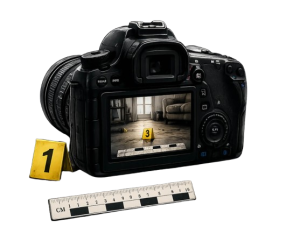 Taking more photographs does not necessarily mean a scene has been documented better. The goal is to create a visual record that accurately communicates the scene. Before photographing an item in close-up, establish where it is located. Capture multiple perspectives when possible, particularly when visibility, distance, or obstructions may later become relevant. When using a measurement scale, consider photographing the evidence both with and without it. Most importantly, preserve original image files and associated metadata whenever possible. A photograph that seems routine today may eventually become the foundation for a forensic reconstruction or courtroom demonstrative.
Chain of Custody
Evidence must be more than collected—it must be accounted for. A clear chain of custody documents who collected an item, who possessed it, when it was transferred, and what occurred during examination or testing. The same principle increasingly applies to digital evidence. Body-worn camera footage, surveillance video, cellphone data, photographs, vehicle data, audio recordings, drone imagery, and laser scans can become central components of an investigation. Preserving original files and documenting how those files were obtained and handled helps maintain confidence in their integrity.
Interview Documentation
Witness interviews may provide critical information about timing, movement, observations, sounds, visibility, and the sequence of events. Whenever possible and legally permissible, record interviews rather than relying exclusively on written summaries 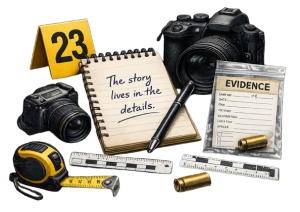 Investigators should distinguish between what a witness personally observed and what they later learned from another source. Be especially mindful of statements such as “right there,” “over here,” or “he went that way.” Those statements may be clear during an in-person conversation but difficult to interpret months later. Use diagrams, maps, photographs, or video to preserve exactly what the witness is describing.
Measurements that Matter
Measurements are among the most valuable pieces of information available when reconstructing a scene—and among the most difficult to recover
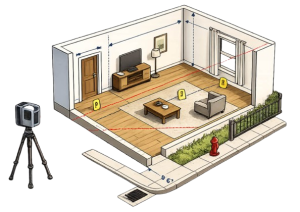
after an environment changes. Whenever possible, measurements should originate from fixed, identifiable reference points.
Think beyond the obvious. Doorway widths, window heights, ceiling heights, roadway dimensions, lane markings, furniture placement, elevation changes, evidence locations, and distances between individuals or objects may all become relevant. Technology such as laser scanning, photogrammetry, and drone mapping has transformed scene documentation, but traditional measurements, photographs, diagrams, and investigative notes remain invaluable.
The Investigator’s Quick Check
Before leaving a scene, ask:
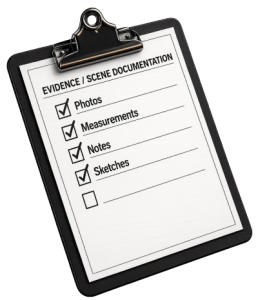
 Did I photograph the entire environment, not just the evidence?
- Do my photographs progress from wide to mid-range to close-up?
- Can someone determine where each important item was located?
- Did I photograph relevant entrances, exits, sightlines, and obstructions?
- Did I collect measurements from fixed reference points?
- Are the beginning and ending points of each measurement clearly documented?
- Did I preserve the original photographs, videos, and digital files?
- Is the chain of custody complete and clearly documented?
- Did I distinguish between what a witness observed firsthand and what they learned later?
- If a witness pointed to a location or direction, did I document exactly what they were indicating?
- Is there anything else I can document now that may be impossible to recreate later?
From the Notebook
Photograph it – You may never have access to the scene again.
Measure it – The environment may change before the case reaches an expert.
Preserve it – Original files contain information that copies and screenshots may not.
Document it – Memories fade. Investigative records remain.
Think ahead – The questions asked two years from now may be very different from the questions being asked today.
 Document Today for the Questions Asked Tomorrow
One of the most important lessons I have learned through reviewing investigative materials is that we cannot always predict which details will become significant later. At Evidence Room, we often become involved months or even years after an incident occurs. By then, the scene may have changed completely. Our ability to analyze an incident, reconstruct an environment, evaluate different scenarios, and develop accurate visual demonstratives depends heavily on what was preserved during the original investigation.
My Advice to Investigators is Simple:
Capture the wide shot. Take the additional photograph. Record the measurement. Preserve the original file. Clarify the witness’s statement. Document who handled the evidence. Once the scene is gone, the investigative record is what remains. And sometimes, the smallest detail preserved today becomes the detail that helps tell the story tomorrow.