Families searching for hope: the growing role Of the private sector in unsolved homicides
Those impacted by homicide are the people left behind to wage a relentless fight for answers. Their fights are fueled by the hope that today will be the day the answers come. Today will be the day investigators call, saying, “We got them! We broke the case!” For too many families, however, that day never comes. Parents enter their nineties never knowing who killed their son or daughter. Spouses become single parents in an instant without knowing why or who. Children never see their mom, dad, brother, or sister again without knowing the name of the person responsible. What do they look like? Why did they do it? Overworked law enforcement agencies with finite resources are the ones responsible for helping survivors move from hope to closure- not only is that a heavy burden, but it is also an uphill battle. Over time, national homicide closure rates have waxed and waned: how can we, the private sector, help? Private forensic investigators should not be and do not want to be a last resort- a call made when hope is running out; instead, what might happen if we are on the team from the start? A team approach seems appropriate, even the gold standard, when considering a question as complex as: who would end another person’s life?
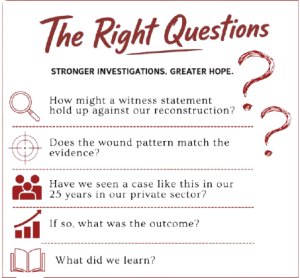 Today, homicide survivors are asking different, more complex questions and wondering if they can be doing more to move their case along. Increasingly, the answer to that question is yes. Private teams of experts and investigators are not a replacement for law enforcement; rather, we complement them and do what the demands of their profession preclude them from doing: communicate with families and test far-fetched, albeit possible theories. Hope lives in knowing people are fighting alongside you. Hope lives in knowing your loved one has not gone forgotten. Hope is the feeling that all of us in this field have had when learning about a homicide victim from their loved ones: I wish I had known them. Hope is collaboration. We bring hope not by taking over, but by strengthening the team with a fresh perspective.
 Perspective is invaluable in complex homicide cases. Investigators and experts in the private sector approach cases inherently differently from law enforcement. We question long-standing, often well-founded theories and ask unique questions. The answers to these questions might reaffirm the original findings by investigators, but they might also point the investigation in a new direction. Both outcomes offer hope; accordingly, both outcomes are of value. No one can be an expert in everything. We know that. Law enforcement agencies know that. Our team is unique in our backgrounds, education, experience, and approach to cases. One team member with advanced ballistics experience might take a theory from investigators and test whether the suspected trajectory can be replicated. Complex scenes and evidence can be presented in new ways so families, eyewitnesses, prosecutors, and juries can understand what happened.
 Collaboration, not Competition
Authority over a case belongs to law enforcement. Private experts are not vying for credit or control; instead, we hope to enhance investigations by leveraging the tools and expertise at our fingertips and by sharing our results to advance our shared goal.
 The Future
Technology and the capabilities of private sector experts are expanding rapidly. Even more encouraging, law enforcement agencies are having increasing success when partnering with private experts, acknowledging the value of a fresh perspective. Justice and hope do not belong to law enforcement or private sector professionals; they belong to the survivors who place their trust in our hands. Looking forward, our sights are set on helping families who place their hope in our hands find answers.